
Credit: © Aaron Favila, Associated Press. All images used with permission.
World Press Photo has officially announced the finalists for its 2026 contest, receiving a total of 57,376 images from 3,747 photographers across 141 countries. A blend of single frames, larger stories and long-term projects make up the finalists, and in this article I’m sharing what I believe are the very best of the best.
About The 2026 World Press Photo Awards
The overall standard of this year’s edition of one of the most prestigious photography awards was incredibly high. I can only imagine how difficult it must have been for the judges to whittle it down to a select few photographers.
I whittle my selection down even further, to offer a different perspective and my take on why I gravitate towards a photograph so much. This, of course, is purely my opinion, and I will link to all of the finalists so you can make your personal judgements as well.
It was pleasing to see some photos included that I remember seeing for the first time when they broke in the mainstream media. Images that, when you see them, make you think “wow, that’s powerful photojournalism right there”.
Speaking on this year’s awards, World Press Photo’s Executive Director, Joumana El Zein Khoury, who I interviewed in 2025, said:
“I have deep respect for the thoughtful process behind every story we award. I believe that the jury’s intentionality is, and will continue to be, the source of the public’s trust in World Press Photo.”
The overall winner alongside two other photographers will be announced on April 23rd.
11 Powerful Images
I will now share my top picks for this year’s World Press Photo contest. You’ll learn a little background about the images and what my take is on each of them. Some may find some of the images distressing, as several finalists are covering the conflicts we’re witnessing happening around the world.
Each image will include the photographer, where they’re from, which publication they worked for and the region the image was made.
Abdulmonam Eassa, Syria/France, Le Monde (Africa)
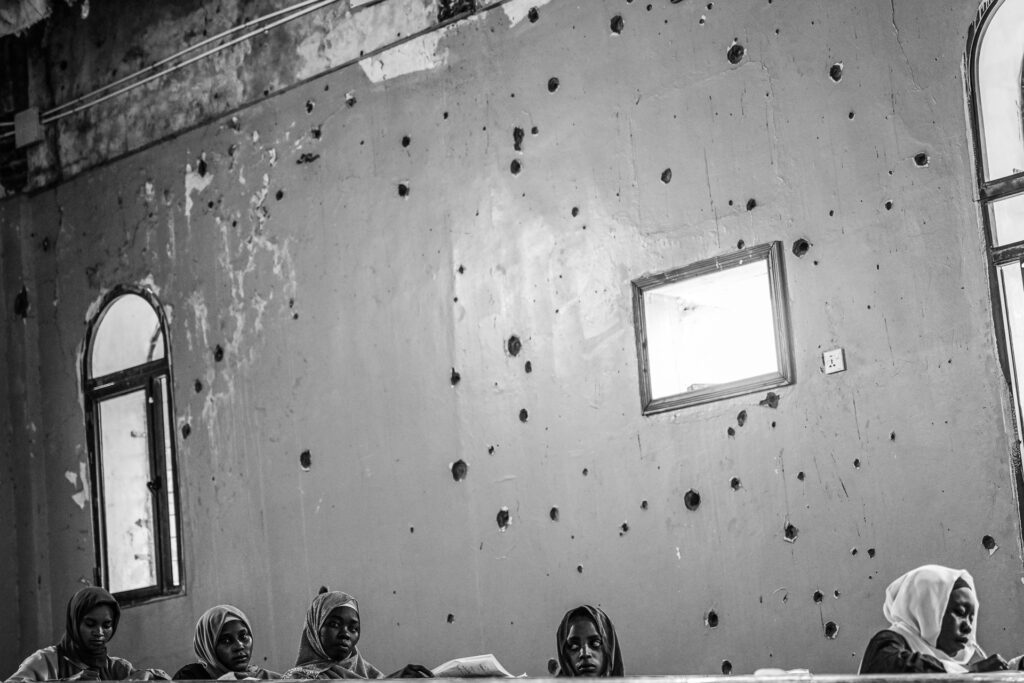
Title: Sudan’s War: A Nation Trapped
Credit: © Abdulmonam Eassa, for Le Monde
Caption: Students take exams at the war-damaged Omdurman Islamic University. Schools and universities have been attacked and mostly closed since fighting began. Omdurman, Sudan, 4 December 2025.
Story: After a 2019 revolution overthrew decades of dictatorship, Sudan’s democratic hopes were crushed by a military coup in 2021. Two years later, the army and paramilitary forces turned on each other, beginning a war that has spiraled into one of the world’s worst humanitarian crises. As famine spreads and essential services collapse, foreign powers continue to fuel the conflict with weapons. Over 13 million people have been displaced, and at least 150,000 killed. The UN reports that civilian killings more than doubled in 2025 compared with the previous year.
My take:
This image immediately stopped me in my tracks. A group of women in what seems to be a classroom environment, heads down, going about their work. Behind them, the walls are riddled with bullet holes, so numerous and so close that it’s a wonder the structure is still standing at all.
It’s a reminder of how fragile life can be, and how even settings that are meant to better the human experience can be turned into conflict zones where life can be taken so quickly.
Tyrone Siu, Hong Kong, Reuters (Asia-Pacific & Oceania)
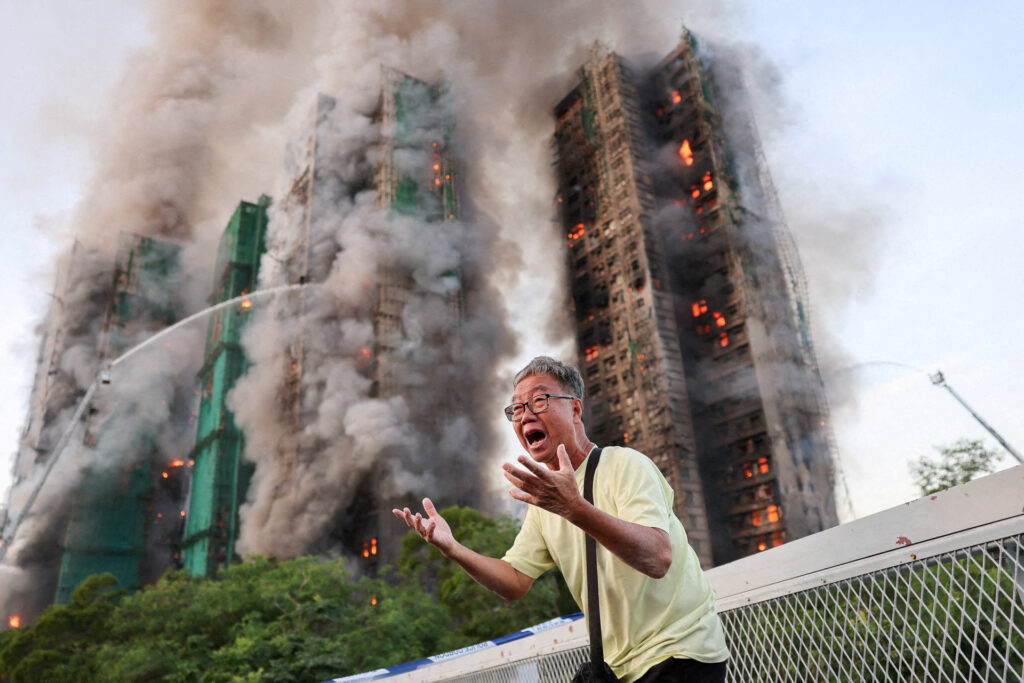
Title: A Desperate Plea
Credit: © Tyrone Siu, Reuters
Caption: Mr Wong cries out in anguish as fire engulfs the Tai Po housing complex he calls home. Moments earlier, he phoned his wife, who was trapped in the building, and they exchanged what would be their final words. Hong Kong, 26 November 2025.
Story: A massive fire at the Wang Fuk Court housing complex in Tai Po claimed 168 lives, becoming Hong Kong’s deadliest fire since 1948. While no official cause has been reported, investigations by Hong Kong authorities found that bamboo scaffolding, construction netting, and flammable Styrofoam boards on windows acted as accelerants for the fire, trapping residents inside. More than 2,000 firefighters were involved in rescue efforts, killing one and injuring twelve.
My take:
I remember seeing this image in the news and realizing then how powerful it was. It perfectly captures the despair people had when witnessing the flames spread rapidly across the apartment blocks. Although the core subject achieved physical safety, his emotional pain is there for all to see. The image helps the viewer empathize with the magnitude of the disaster.
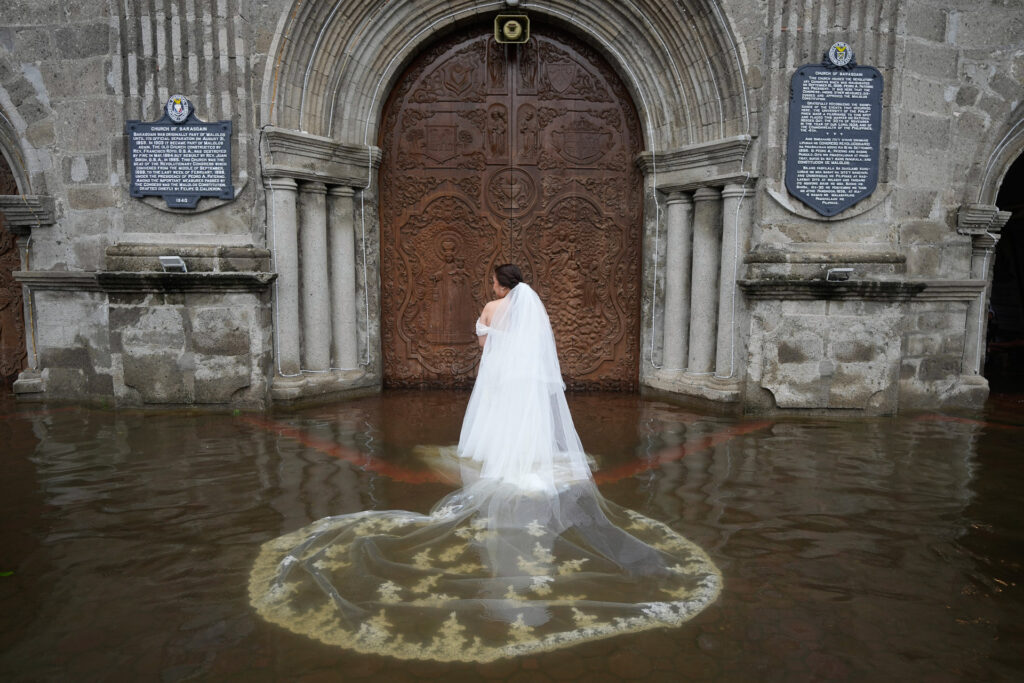
Aaron Favila, Philippines, Associated Press (Asia-Pacific & Oceania)

Title: Wedding in the Flood
Credit: © Aaron Favila, Associated Press
Caption: The newlyweds share a kiss as guests cheer. The couple have been together for ten years. According to Verdillo, “This is just one of the struggles that we’ve overcome.” Malolos, Bulacan province, Philippines, 22 July 2025.
Story: When Typhoon Wipha hit the Philippines and flooded Barasoain Church, Jade Rick Verdillo and Jamaica Aguilar faced a difficult decision: should they cancel their wedding or proceed with the marriage? The couple carried on despite high waters, a testament to love and resilience in the face of severe weather. Located on a delta, Bulacan province is vulnerable to more frequent and extreme floods caused by aging drainage systems, dredging projects, overextraction of groundwater, and climate change.
My take:
A wedding day is designed to be one of the best days of people’s lives. But, with that comes a lot of pressure for things to run perfectly, and sometimes mother earth has a different plan than the one you expected.
This image, shot amongst the floods in the Phillipines, shows a different story. Regardless of the adversity you face, love can prevail, and that’s where perfection comes from, not solely the external circumstances.
Paula Hornickel, Germany (Europe)

Title: Emma the Social Robot
Credit: © Paula Hornickel
Caption: Waltraud talks with Emma, a social robot that recognizes faces and remembers past conversations. Though skeptical at first, Waltraud says she felt connected to Emma over time.
Albershausen, Germany, 3 July 2025.
Story: Germany’s care homes are facing two crises: staff shortages and loneliness. A 2023 study found that one in five residents aged 80 and older describe themselves as “severely lonely.” This reality has prompted trials of social robots like Emma, developed by a Munich-based startup. Waltraud, a resident of Haus im Wiesengrund in Albershausen, had her doubts but over time formed a bond with Emma. “When she tells her jokes, that’s really good. That’s my kind of humor,” says Waltraud, though she emphasizes that human contact is always preferable.
My take:
Loneliness in later years is a global issue many people face. When first viewing this image I was conflicted. At first, I was sad that this woman was in a position where she had to turn to technology for connection. But, then I came to think if this robot can soothe the pain of isolation, then should there really be a problem?
A sign of good photojournalism is an image that not only tells a story, but also drives conversation and asks humans to think about how we ease some of the burdens we face throughout a lifetime.
David Guttenfelder, United States, The New York Times (Europe)
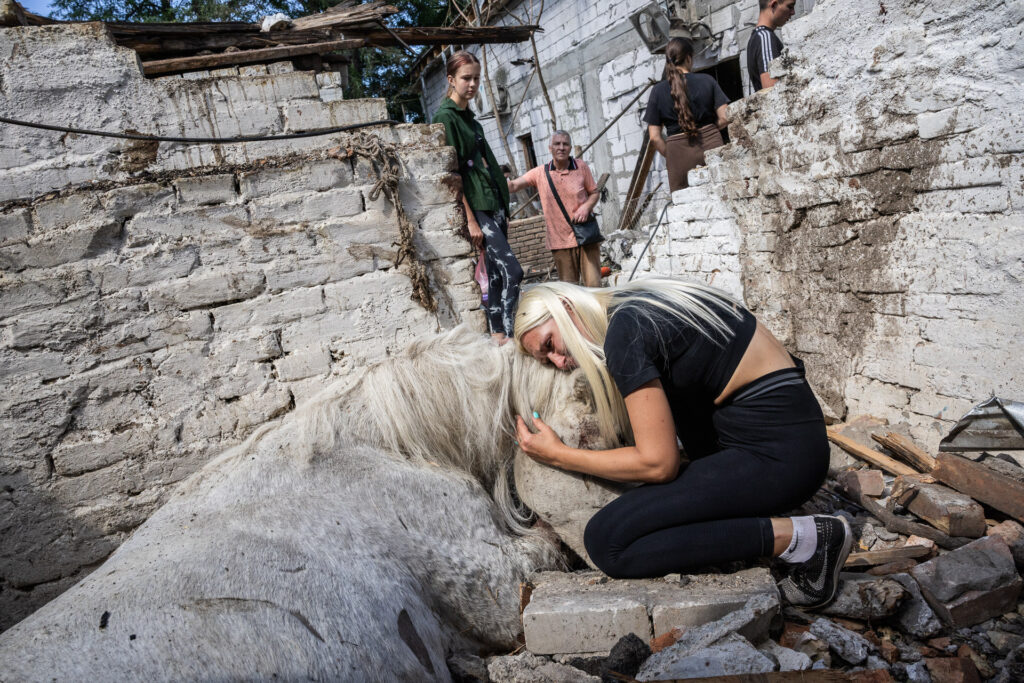
Title: Drone Wars
Credit: © David Guttenfelder, The New York Times
Caption: Yulia Vasiakina embraces Kamelia, her 20-year-old horse, killed when Russian long-range drones struck their neighborhood and destroyed most of the surrounding city block. Odesa, Ukraine, 11 July 2025.
Story: Ukraine’s battle against the Russian invasion is reshaping modern combat. Hobby drones are being repurposed into remote-controlled weapons, and mass-produced first-person-view (FPV) drones are piloted from kilometers away with deadly precision. These developments have triggered an unrelenting drone arms race and turned vast areas of Ukraine into “kill zones”. Civilians are targeted and displaced, and soldiers spend most of their time in underground bunkers or basements, unable to be resupplied or casualty-evacuated. This story documents Ukraine’s efforts to advance its drone capabilities, and the impact of Russian drone attacks on civilians.
My take:
If you love animals or can empathize with those that do then you’ll agree this image is heartbreaking. A home destroyed, a horse’s life taken with it, the human responsible for the horse having her last moments with it in her arms. Nothing can be done to change what has happened, and the photo demonstrates how impossible life can feel.
Sanna Sjöswärd, Sweden/Iran, Corren (Europe)

Title: Engla Louise
Credit: © Sanna Sjöswärd, for Corren
Caption: Engla Louise’s “bed ballet” – movements performed lying down – keeps her connection to dance alive. Every day at a specific time, she watches ballet on her iPad. Linköping, Sweden, 22 December 2025.
Story: Engla Louise, a former dancer, has lived with severe anorexia nervosa since she was ten years old. At 46, she weighs less than 25 kilograms and has been tube-fed since 2019. Researchers increasingly describe anorexia as a disease of both body and mind. Its causes – not fully understood – are thought to involve neurobiological, genetic, and environmental factors. After decades of treatment, Engla Louise is now considered therapy-resistant and receives palliative care at home. This project aims to broaden the discussion about care for people living with severe eating disorders.
My take:
I almost didn’t publish this image. Not because it was more distressing than any other, but because my mind couldn’t comprehend what I was viewing. Which made me realize that’s exactly why I should publish it and why images like this are so important for conversations surrounding physical and mental disorders like, as in this case, severe anorexia nervosa.
It’s not easy seeing one individual struggle like this. I can’t even begin to imagine what her daily experience is like. But I do know photo stories like this can drive awareness and hopefully lead to better research and outcomes for people struggling with medical conditions.
Carol Guzy, United States, Zuma Press, iWitness, Miami Herald (North & Central America)
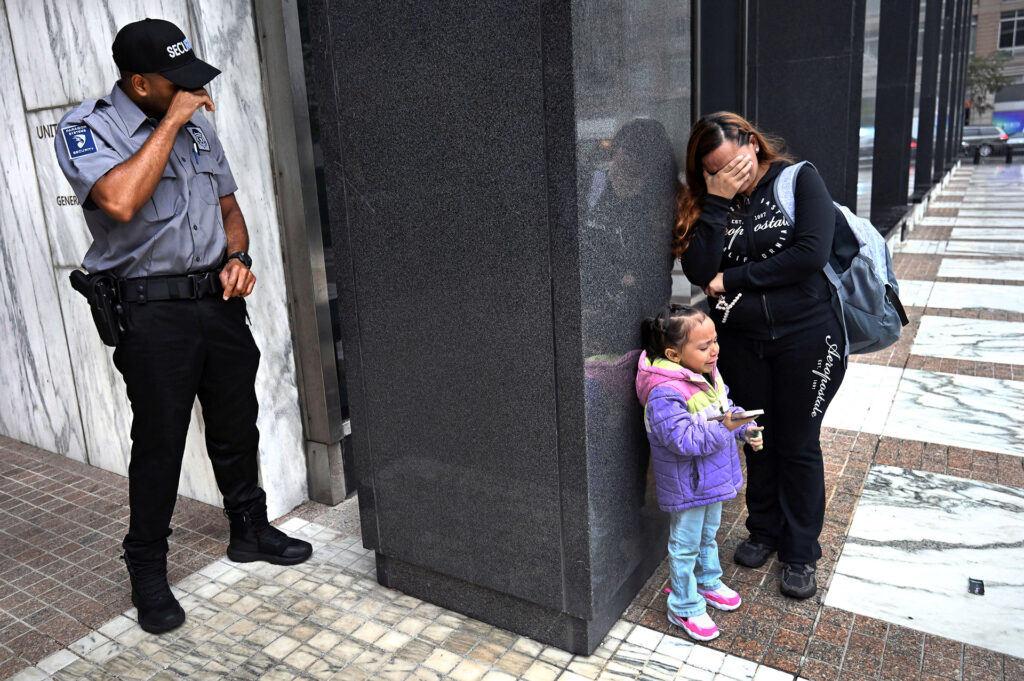
Title: ICE Arrests at New York Court
Credit: © Carol Guzy, ZUMA Press, iWitness, for Miami Herald
Caption: A security guard breaks down while witnessing a family separation. Security personnel frequently find themselves caught between federal agents, desperate families, and protesters in the increasingly volatile courthouse environment. New York City, New York, United States, 20 August 2025.
Story: In 2025, shifts in US immigration policy transformed courthouses into focal points for mass deportation efforts by US Immigration and Customs Enforcement (ICE). Masked ICE agents detained undocumented migrants immediately following their hearings, often leading to deeply traumatic family separations. These aggressive tactics, coupled with severely overcrowded and unsanitary conditions at the 10th-floor holding facility in the Jacob Javits Federal Building in New York, prompted fierce public protests, class-action lawsuits, and the arrest of local elected officials demanding accountability.
My take:
Those in power love nothing more than to create an “us versus them” divide, and there’s no better example of that than the ongoing anti illegal immigration project happening in the United States.
This photo, however, shows that walls can be broken through and even people trained to remove their empathy for others can allow human instinct to shine through and show a level of understanding of how terrible it must be to have your family ripped apart.
Ethan Swope, United States, Associated Press (North & Central America)
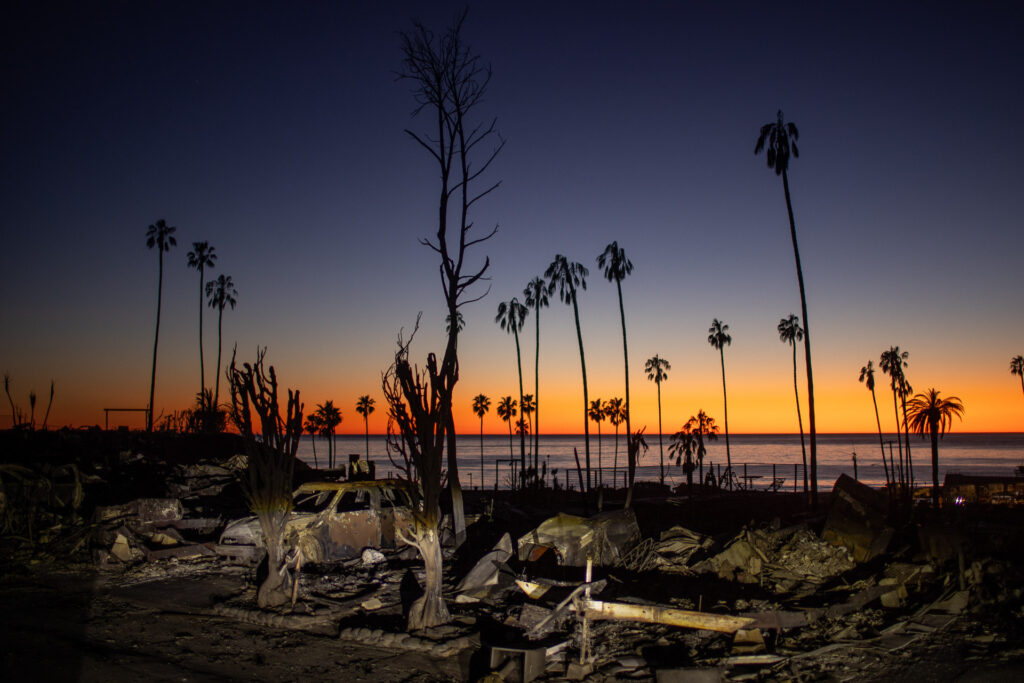
Title: Los Angeles on Fire
Credit: © Ethan Swope, for Associated Press
Caption: The devastation of the Palisades Fire is visible at sunset. Experts emphasize that the extended, drier fire seasons in Southern California are exacerbated by human-caused global warming trends. Los Angeles, California, United States, 14 January 2025.
Story: In January 2025, severe drought and 100-mph (roughly 160-kph) Santa Ana winds fueled 14 devastating wildfires across Los Angeles, destroying over 18,000 buildings and displacing 200,000 residents. While officials reported 31 direct fatalities, public health studies estimate 440 excess deaths linked to toxic smoke and disrupted medical care. In the disaster’s aftermath, a stark wealth divide has defined recovery efforts, with lower-income residents facing displacement while wealthier communities leverage private resources to rebuild.
My take:
Taken during the fires in Los Angeles, this image perfectly highlights how glorious and yet destructive life can be. In the foreground, debris and destruction as the fall out of the fires shows all that was lost. And, in the background a stunning sunset, reminding us of all we have been given – pain and glory in a single frame.
Saher Alghorra, Palestine, The New York Times (West Central & South Asia)
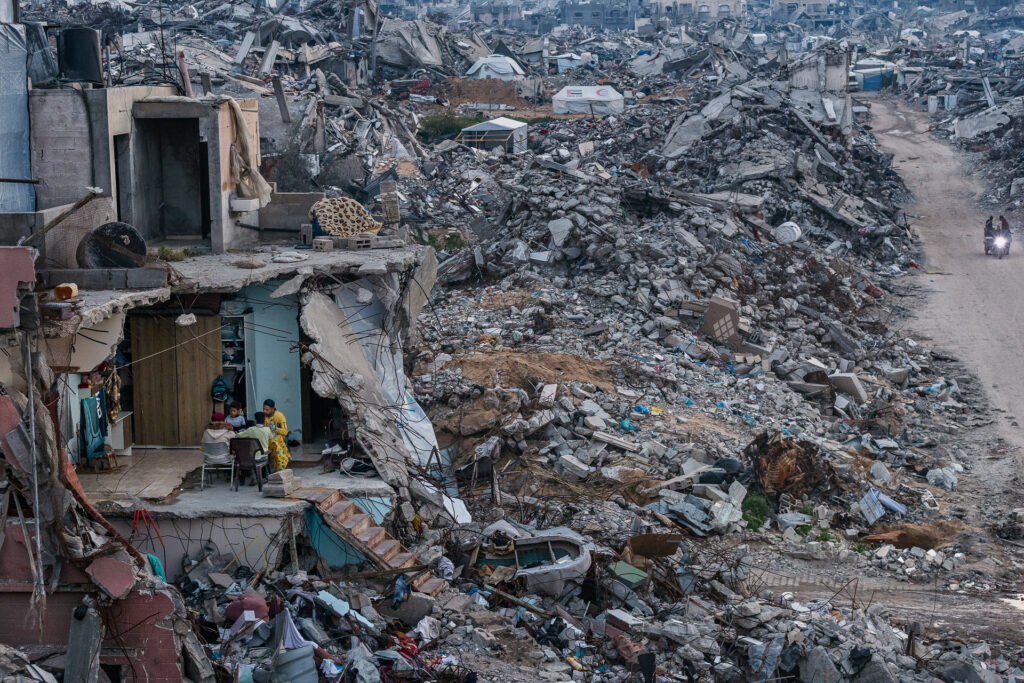
Title: Witnessing Gaza
Credit: © Saher Alghorra, for The New York Times
Caption: Tamer Hassan al-Shafei and his family break their Ramadan fast in the remains of their home. Food shortages meant only basics were served instead of the usual spread. Beit Lahia, Gaza Strip, 4 March 2025
Story: In 2025, civilians in Gaza endured starvation, famine, and relentless bombardment as the death toll surpassed 75,000 and Israeli authorities severely restricted the flow of humanitarian aid. A ceasefire agreement in October has yet to bring meaningful relief. Palestinian journalists – living through the reality they document – are the world’s few witnesses to what a UN Commission has concluded is a genocide. Israel disputes this. The photographer worked under immense danger, driven by a refusal to let the world turn away. “Even when everything around me told me to stop, I couldn’t – silence would mean surrender.”
My take:
For many of us living in the west, it’s impossible to comprehend what life must be like living in conflict zones in cities like Gaza. What’s striking about this image, is how even amongst the rubble and debris, for some people life simply must go-on.
It also shows such a high-level of defiance, as even though it may be a matter of time before the last remaining structures are destroyed, people refuse to change their routines, and something as simple as a family coming together at a dinner table will not be taken away.
Rob G. Green, United States, National Geographic Society, Henry Luce Foundation, (Asia-Pacific & Oceania)
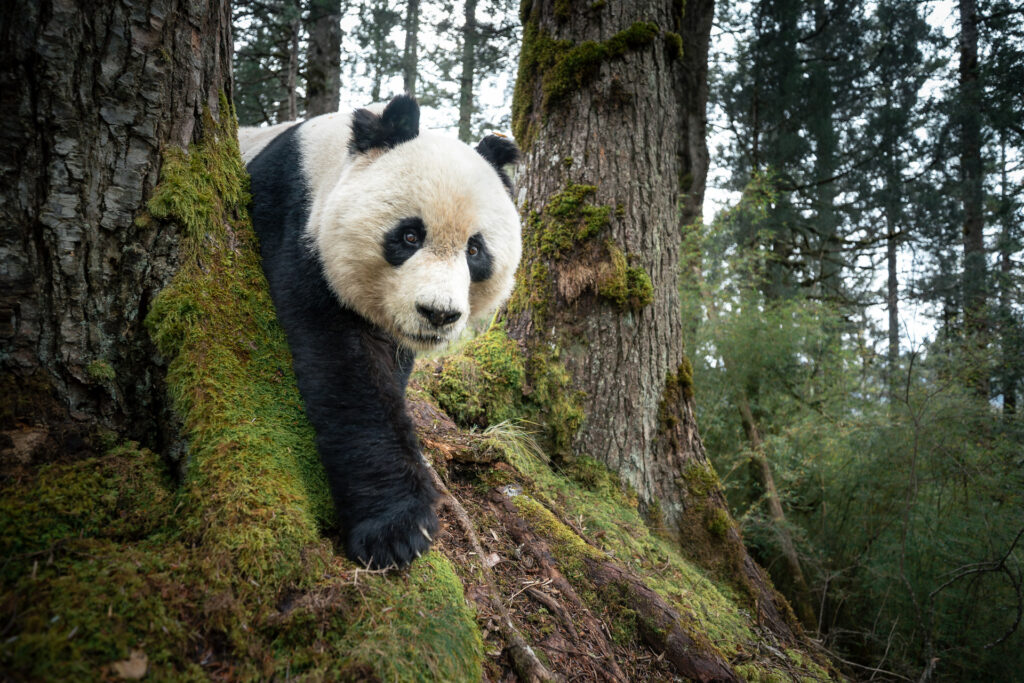
Title: Mountain Resident of Wanglang
Credit: © Rob G. Green, National Geographic Society, Henry Luce Foundation
Caption: A wild giant panda is captured by a camera trap in the Wanglang National Nature Reserve. Sichuan, China, 11 November 2025.
Story: Recent population estimates suggest that fewer than 2,000 pandas remain in the wild, and only a few dozen individuals live within Wanglang National Nature Reserve’s 323-square-kilometer territory. This rare sighting was made possible through a pilot exchange program between the National Geographic Society and wildlife biologists, aimed at supporting wildlife monitoring efforts and fostering cross-cultural cooperation in conservation. Established in 1965, Wanglang is one of China’s oldest wild panda nature reserves and today serves as a key site for education and scientific research collaboration within the larger Giant Panda National Park system.
My take:
Amongst the pain and despair was this image. A cute, cuddly photograph of a Panda who seems to be somewhat enjoying their time being the focal point of the frame. It’s the cuteness that sucks you, long enough to learn the full story.
The reality is sightings of wild Panda’s is rare, and right now it’s estimated only 2000 remain out in the wild. This really is one of those “you had to be there to believe it moments” and it shows how photography can help share those instances with the rest of the world.
Pablo E. Piovano, Argentina, Manuel Rivera-Ortiz Foundation, Philip Jones Griffiths Foundation, Lawen.doc (South America)
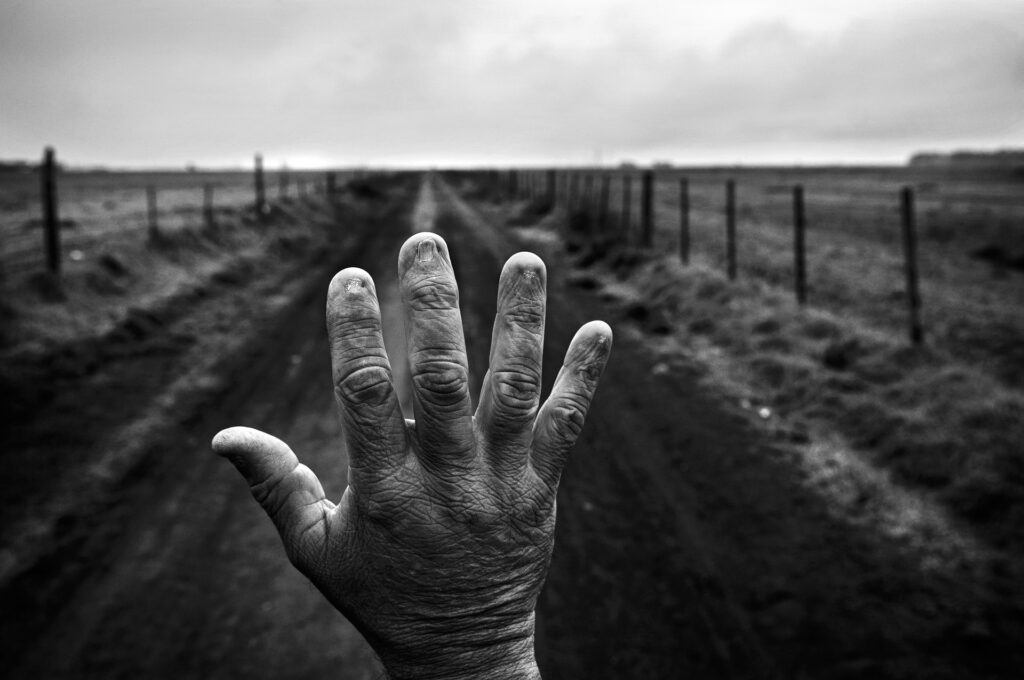
Title: The Human Cost of Agrotoxins
Credit: © Pablo E. Piovano, Manuel Rivera-Ortiz Foundation, Philip Jones Griffiths Foundation, Lawen.doc
Caption: Former land applicator Alfredo Cerán shows his burned fingernails. After years of mixing chemical products without adequate protection, he developed non-alcoholic cirrhosis and underwent a liver transplant. Cordoba, Argentina, 23 September 2015.
Story: In 1996, Argentina approved genetically modified, herbicide-resistant soybeans paired with glyphosate-based herbicides, a policy adopted without independent research. In three decades, pesticide use skyrocketed from 40 million to 580 million liters annually. Today, 60% of Argentina’s cultivated land is sprayed, affecting 14 million people. Despite independent studies linking exposure to increased risks of cancer and congenital malformations, regulations continue to loosen even as agrochemical usage moves closer to human settlements. This project documents the human cost of an economic model that prioritizes agro-industrial profit over the lives of its rural citizens.
My take:
Here is a hand that wears the scars of someone who has walked down many hard paths in life. The leading road in the background makes this frame almost poetic. Though, most importantly, it also highlights the consequences people face when working in harsh conditions. It is an image of human sacrifice that’s made for capital gain.
Singing Off
I’m certain this years’ finalists will remind you of how important photojournalism is to society. I think all these images force you to feel, and continue conversations society should be having. What are your thoughts on my selection?
You can see the full list of finalists on the World Press Photo website.
More reading: Incredible Image of Earth Reminds Us of Photography’s Power