
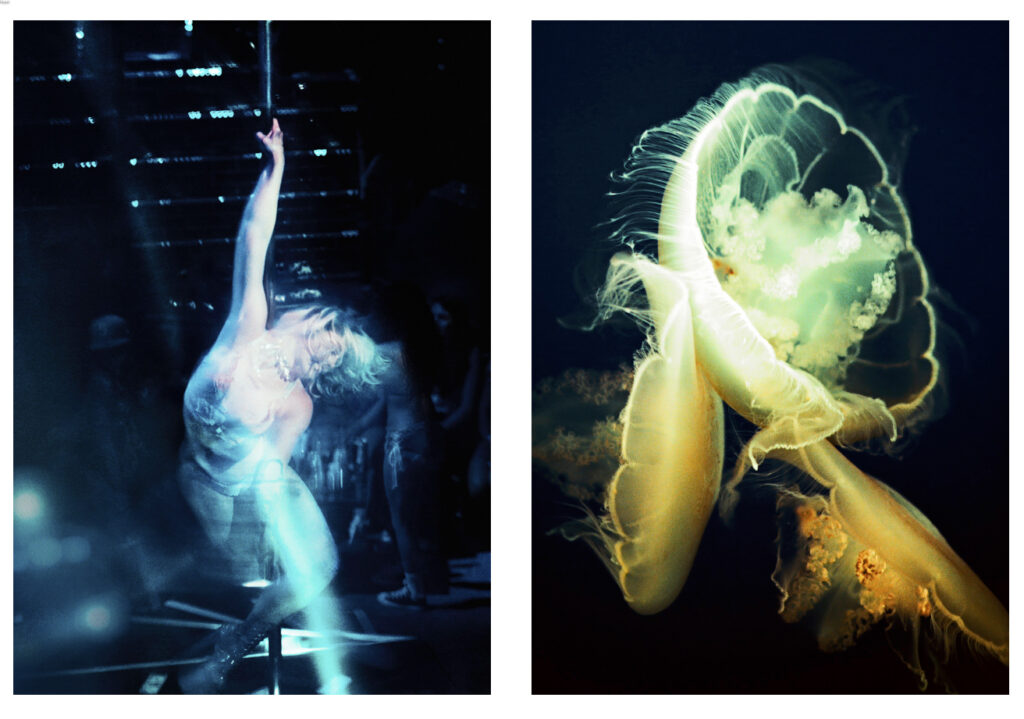
Credit: Elizabeth Waterman
It started at an aquarium.
Elizabeth Waterman was at Long Beach with her husband, snapshot camera in hand, when she stopped in front of the jellyfish tank. She had always liked them. Their strangeness. The way they move. She took a few frames on flash and went home.
When she developed the roll and held the prints next to photographs she had been making of pole dancers at events across Los Angeles, something clicked.
“I put the two next to each other and I thought it was kind of cool,” she says. “I called my husband into my office. He flipped out [with excitement].”
That was 2020. Six years later, that accidental pairing has since become Propulsion and will be displayed as twelve diptychs premiering at Photo London this May, presented by Albumen Gallery.
Creating The Diptych
The connection between the two subjects is partly visual. Bodies in motion, caught mid-gesture, lit against dark backgrounds.
But it runs deeper than that.
Both produce the same reaction in whoever is watching. The jellyfish moves through water in ways that seem almost choreographed. The dancer moves through air in ways that seem almost impossible. You look at both and think: wow, what is that?
“It’s the same moment,” Waterman says. “Your mouth drops open. It’s this moment of whoa.”
What the diptych does is hold that sensation long enough to question it. Waterman has always seen pole dancers differently to how the world tends to see them. “I have always seen dancers and adult workers as really cool, glamorous, magical creatures,” she says. “They mesmerize people. They are just a sight to behold.”
When placed beside a jellyfish, something shifts. Viewers who might approach a photograph of a pole dancer carrying a set of assumptions find those assumptions quietly dismantled by what sits beside it. “When I show people these diptychs, they say they weren’t even really paying attention to the fact that it was a dancer,” she says. “They’re just caught by the beauty of it.”
The work is not a provocation. It is an invitation. “If it just shifts their perception a little bit, shaped by awe, that’s enough.”
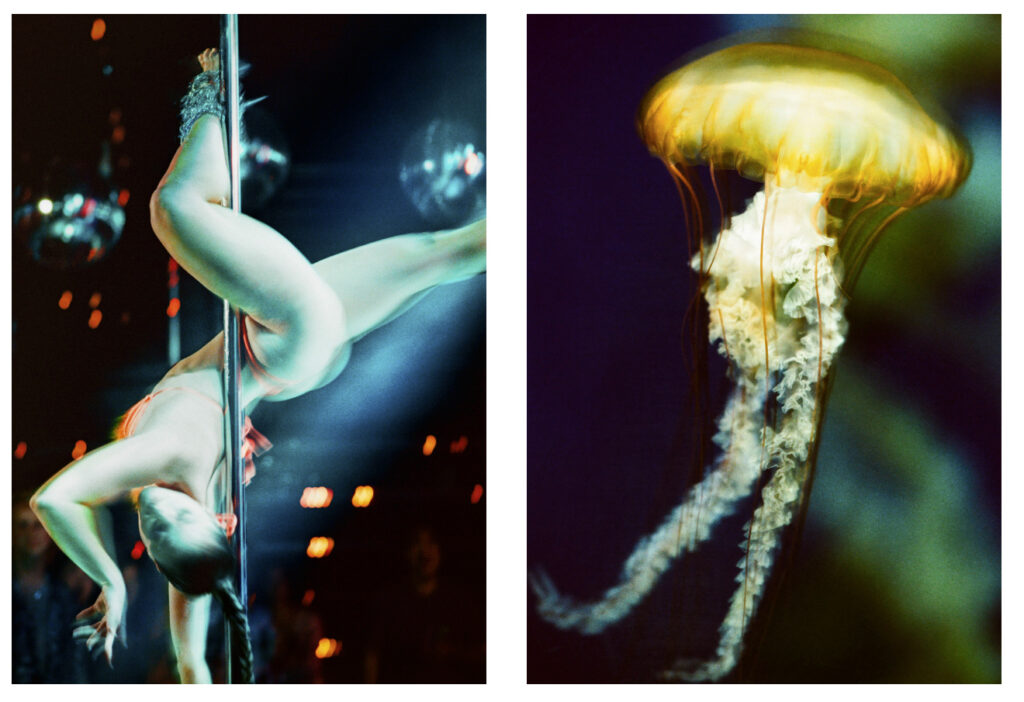
Credit: Elizabeth Waterman
How the Work Evolves
What began with a snapshot camera became something more considered over time. Waterman moved to large-format optics. She refined her lighting approach, using a small pop of flash balanced against the low ambient light of each environment. She found a specific way of processing the film. Crucially, she shoots both subjects the same way. The technical consistency quietly reinforces what she is saying about them.
She has photographed jellyfish in aquariums all over the world. Some cleared the space entirely and gave her full access. Others were more limited. All, she says, were welcoming. Eventually her husband, also a photographer and her closest collaborator, called time. “He was like: you’re done. You have enough for a book. You have enough for a gallery show.”
Scarcity as Statement
Stephan Schmid, Director of Albumen Gallery, sees Propulsion as a natural evolution. “In some ways Elizabeth Waterman’s most recent body of work represents a logical next phase in her creative journey,” he says. For Schmid, the diptychs take her long-standing exploration of eroticism and sensuality into broader territory. “A wider context of sensual life,” as he puts it. “Testament to her continued creative inquisitiveness.”
At Photo London, Propulsion will hang alongside Ancient Dialogues by William Stewart. Stewart’s series pairs ancient statues with contemporary nudes, reviving the sensuality of classical aesthetics and examining its long suppression.
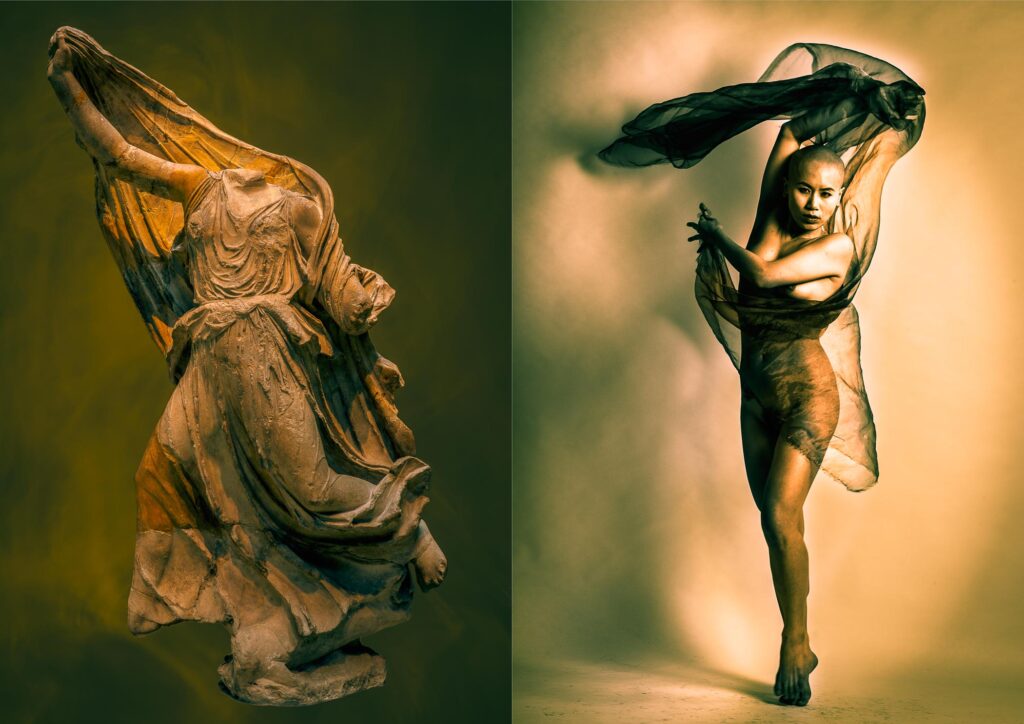
Credit: William Stewart
Both bodies of work use the diptych as a space for dialogue between subjects, between eras, and between the viewer and what they think they already know.
Waterman has shared only two pairings publicly ahead of the show. In a moment defined by relentless image production, she has gone the other way. “We live in an era of this onslaught of content,” she says. “It leads to the deterioration of work and of spirit.”
The prints are released in small editions and the larger works in editions of five. Shot on analog film, each one is slow and considered and they’re rare, in every sense.
For Waterman, that rarity is not a marketing strategy. It is something closer to a responsibility. “I view it like I’m the mother of this work,” she says. “But it ultimately belongs to God. I am being a steward. I am taking care of it.”
Photo London runs 14–17 May 2026 at the National Hall, Olympia London. Albumen Gallery, Booth B10. Visit the website for more details.
You can see more work from Elizabeth Waterman by visiting her website.
Visit William Stewart’s website to enjoy more work from him.
More reading: The Apple Engineer Changing the Way You See Nature